
Handling an Incoming Call
If your status is set to Ready on the voice channel in the Gplus Adapter for Salesforce, you can start receiving calls at any time. When the call comes in, you can scroll through the configured fields, such as Case Information, Participants, Disposition, and Notes to find out more information before you accept or reject. You can expand or collapse these sections by clicking the little arrow ( ) next to the section name.
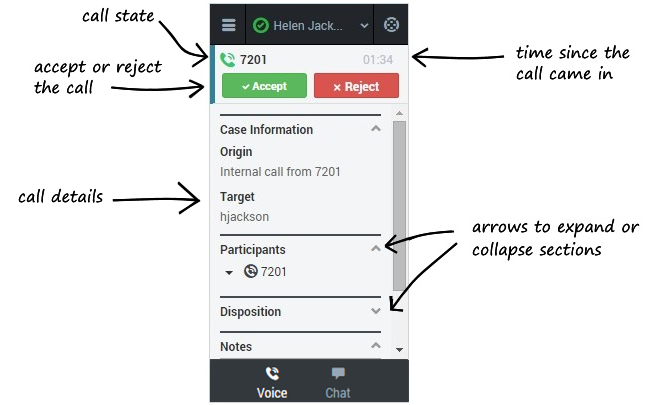
If you Reject the call, you'll be taken back to the main view for the voice channel. If you accept the call, you'll see a call section at the top of the adapter with a list of actions you can take; the rest of the adapter still displays the call information.
During the call, there are lots of actions you can take. You can see the full list at the top of the call screen:
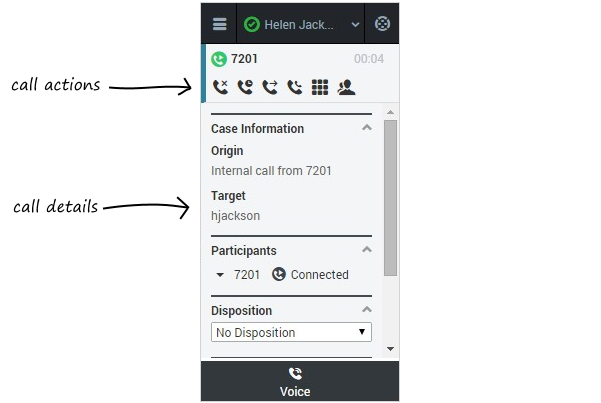
| Action | Button | Description |
|---|---|---|
| Hang up | 
|
Ends the call. |
| Hold | 
|
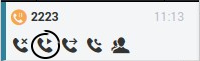
Places the call on hold. If you do this, you'll see a slightly different list of actions with a Retrieve button ( ): ):
 |
| Instant Transfer | 
|
Redirects the call to another contact you select using Team Communicator. See Transferring a Call for details. |
| Instant Conference | 
|
Starts a voice conference instantly with the current call and another contact you select using Team Communicator. See Initiating a Conference Call for details. |
| Keypad | 
|
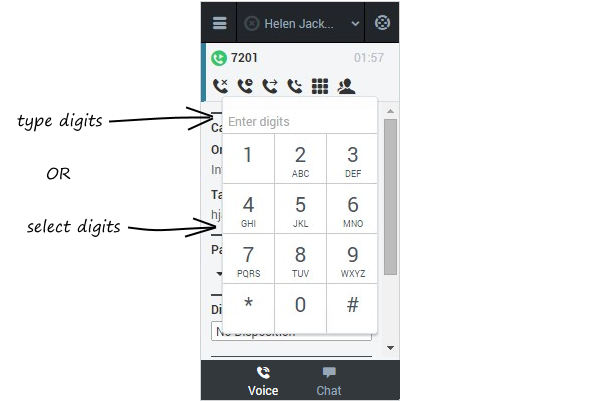
Calls up the keypad. You can use this to attach numerical data to the call by entering dual-tone multi-frequency (DTMF) digits into the call case history. Enter or select the digits and then hit Enter on your keyboard.
 |
| Consult | 
|
Starts a consultation with another contact before transferring or conferencing the call to that contact. See Initiating a Consultation for details. |
Content TDB below this point
Case Information
The Case Information (attached data) view provides information about an interaction — for example, an account number or type of service. Your system administrator configures which attached information is displayed.
The following are examples of the type of critical information the Case Information view provides about the active interaction:
- Contact name
- Call type
- Account information
- Subject
Disposition Code
The Disposition Code view enables you to assign one code to an ongoing or terminated interaction to qualify the outcome of the interaction.
The Disposition Code view is a menu in the Interaction view. It contains a list of choices that you can click to specify the outcome of the interaction:

Select a disposition for the interaction from the list of dispositions avaialable:

Once a disposition is selected, the disposition list is hidden.
Note
The Notes is a feature that enables you to enter comments about the current interaction or about a selected interaction in the History database.
The comments are stored as a part of the history for the contact. The contents of the Notes can be viewed by any agent who views the contact's history.
Notes is available as a field in the following view:
- Voice Interaction
Type notes in the Note text field and click the Mark Done icon ( ).
).
Adding Transfer Notes
The Notes field can also be used in the case where one agent needs to provide additional information to another agent who is set to receive a conference or transfer. Prior to initiating the conference or transfer, the first agent adds whatever information is required to the call note field and then proceeds with the conference or transfer.
When the second agent receives the call, the call note field is populated, allowing them to review and pick up where the first agent left off. This is particularly useful in cases where customers may need to be blind transferred and the first agent is not able to speak directly with the second agent prior to hanging up from the call.