
Deploying the Screen Recording Client
Contents
Genesys Interaction Recording (GIR) needs a Screen Recording Client installed on each Agent's desktop to enable the Agent to capture what is happening on their screen at the time of an active interaction.
Installing the Screen Recording Client
Single Monitor:
- 1024 x 768
- 1280 x 720
- 1600 x 1200
- 1920 x 1080
Dual Monitor:
- Side-by-side 1024 x 768 + 1024 x 768
- Side-by-side 1280 x 720 + 1280 x 720
- Side-by-side 1600 x 1200 + 1600 x 1200
- Side-by-side 1920 x 1080 + 1920 x 1080
- On the Agent's desktop, install the Screen Recording Client using command line.
The client is distributed using a setup.exe file. To run the setup, a user with administrative right is required. An administrator may choose to run the setup program using command line switches. The following is an example of the command line:setup_<version>.exe /VERYSILENT /SUPPRESSMSGBOXES /DIR="C:\Genesys\SRC" /NOCLOSEAPPLICATIONS /SERVER="https://<Web Services IP Address>:<Web Services Port>
This example shows that the command line starts a silent installation in the C:\Genesys\SRC directory, and will configure the server address
ImportantTo debug problems with the installation, you can add the /LOG="logfilename" command to the installation path. For example, setup_<version>.exe /VERYSILENT /SUPPRESSMSGBOXES /DIR="C:\Genesys\SRC" /NOCLOSEAPPLICATIONS /LOG="C:\src_setup.log".If the Agent is using Workspace Web Edition, the desktop requires a secure connection (the URL has https:// as the prefix) to Web Services. The Screen Recording Client is also required to support a secure connection with Workspace Web Edition, so it can accept credentials to Web Services.
Add the /TASKS="HTTPS" parameter during installation to enable secure connection. The parameter will generate unique self-signed certificates and will configure the Screen Recording Client to use them. It will add the certificates to the Windows certificates store under "Trusted Root Certification Authorities". The following is an example of how to use the /TASKS="HTTPS" parameter:
setup_<version>.exe /VERYSILENT /SUPPRESSMSGBOXES /DIR="C:\Genesys\SRC" /NOCLOSEAPPLICATIONS /TASKS="HTTPS"
ImportantThe default installation will NOT install the Screen Recording Client's self-signed PFX certificates to the root certificates store, nor will the Screen Recording Client use the certificates when setting up an HTTPS server for Workspace Web Edition. For more information, see Creating Self-Signed Certificates.Configuring During the Installation
You can also configure the Screen Recording Client when installing it by adding the client side parameters to the command line.
For example, the following code snippet will install SRC and configure the server parameter:
setup.exe /VERYSILENT /server="https://192.1.1.1"
You can also provide the path to the configuration file using /CONFIG="C:\path\to\config.json". The default configuration file will be overwritten. If both are supplied, first, the configuration file will be copied, then the supplied parameters will be added to that file.
For example:
setup.exe /VERYSILENT /server="https://192.1.1.1"
setup.exe /VERYSILENT /CONFIG="C:\path\to\config.json"For more information about the parameters, see the Configuring the Screen Recording Client section.
ImportantYou can configure those parameters that are contained in the first table below.Silent Install Using Answers File
You can also use an answers file to run the setup. To create an answers file, start the setup with /SAVEINF=”answers_file”. All options set in the setup execution will be written to the file. To run the setup using a predefined answers file, use the /LOADINF=”answers_file” command line switch. The following is an example of an answers file:
[Setup]
Lang=english
Dir=C:\Program Files (x86)\Genesys SRC
Group=(Default)
NoIcons=0
Tasks=
- After running the setup, modify the <installdir>\config.json file, and include the following information:
[ { "name": "server", "value": " <Web Services server>:<Web Services port>" }, { "name": "certificate" "value": "true" } ]ImportantThe certificate is an optional parameter in config.json file. It indicates how the screen recording client validates the server TLS certificate. If set to false (the default value), the screen recording client will not validate the certificate. If set to true, the client will validate the certificate using the Windows certificate store when the server is using a certificate from the public CA. If set to a file path (for example, C:\\Automation\\server.pem), the screen recording client will validate the certificate using a self-signed certificated when the server is using a private self-signed certificate. - Restart the Agent's computer.
Creating Self-Signed Certificates
If you did not use the /TASKS="HTTPS" parameter to install the Screen Recording Client, create self-signed certificates as follows:
- Open a command window as an Administrator.
- Navigate to the <install_dir>\Certificates\Self-Signed directory.
- Run the create_certificates.bat file. This creates a set of unique self-signed certificates.
- Run the install_certificates.bat file. This installs the new self-signed certificates to windows trusted certificates store.
Installing Your Own Certificates
Alternatively, you can provided you own certificates without any configuration changes as follows:
- Provide a certificate for the IPv4 host, 127.0.0.1, in the <install_dir>\Certificates\server.pem file.
- Install the .pfx form of this certificate to the local certificates store as a "Trusted Root Certification Authority" file.
- Provide a certificate for the IPv6 host, [::1], in the <install_dir>\Certificates\serverIp6.pem file.
- Install the .pfx form of this certificate to the local certificates store as a "Trusted Root Certification Authority" file.
- The PEM certificate files should include both the private RSA key and the certificate itself. [+] Show an example.
Upgrading the Screen Recording Client
The Screen Recording Client will automatically upgrade any new version on the client machine.
- The following steps must be performed by a System Administrator.
- If the Screen Recording Client version is at least build 297, the Screen Recording Client will automatically upgrade any new version on the client machine. If you are using an earlier build than this, you will need to follow the Install steps to prepare the system for future automated upgrades.
Uploading a New Version to the Web Server
Each new release includes two files:
- setup_<version>.exe—Use for a full upgrade.
- setup_update_<version>.exe—Use for a lite upgrade when there are no changes in software architecture
Depending on the type of update required, upload the setup_<version>.exe file or setup_update_<version>.exe file to the Web Server that does not require HTTP authorization. For example, http://<IP Address>/src/setup_update_<version>.exe.
Configuring Genesys Framework to Push a New Version to the Agent's Desktop
- Update the Web Services Cluster application object in the configuration database. On the Annex tab, edit the screen-recording-client section and add the parameters.[+] Show the table that describes the parameters.
- Restart the client machines to push the new version of the Screen Recording Client to the machines.
Configuring the Screen Recording Client
The Screen Recording Clients running on all desktops can be configured centrally.
- If your server uses a self-signed certificate, set the certificate parameter to the path on the file system where the pem file is stored.
- Edit the local config.json file on the Screen Recording Client machine, and add the client parameters. [+] Show the table describing the parameters.
- Using Genesys Administrator Extension, configure the Screen Recording server parameters.
- At Environment level, locate the Web Services Cluster application object that was created during the Web Services installation.
- Edit the application object, and create a new section named screen-recording-client. The following figure provides an example of the screen-recording-client section.
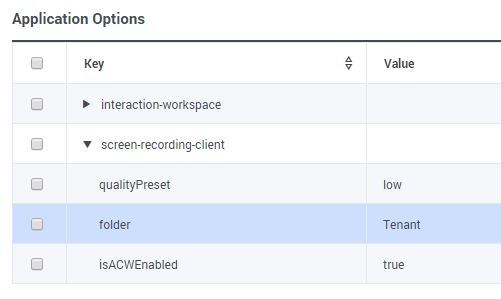
[+] Show the table describing the parameters that can be added to this section.
Enabling Screen Recording
ImportantBefore you can start to capture and playback the screen recordings, you must make sure that you have configured the Web Services components, and encryption specifically for screen recording.To set up recording conditions, add the recordingWhen parameter to the screen-recording-client section of the Web Services Cluster object.
When this parameter is set in the Web Services Cluster object, the recording condition applies to all agents in the environment. You can create the recordingWhen parameter in a screen-recording-client section of each agent object to override the settings at the environment level.
The parameter value is an expression of conditions to enable screen recording for each agent. The format is:
- For Non-voice agents: recordingWhen=condition1,condition2,... where condition1,condition2, etc. are a set of conditions that must all be true in order for the screen recording to be taking place.
- For Voice agents: Screen recording starts when recordingWhen is not set to off and the voice recording starts.
Integrating with Workspace Web Edition
If your agents use Workspace Web Edition as their desktop, screen recording must be set up as follows to support single sign on:
Using Genesys Administrator Extension, add the following parameters to the interaction-workspace section of the Web Services Cluster object.
ImportantIf you are working with HTTP, the Screen Recording Service default port number is 8080. If you are working with HTTPS, the default port number is 443. In addition, verify that the Workspace Web Edition configuration is set to 8080 or 443.Parameter Name Mandatory Description Default Value privilege.screen-recording.can-use Y Specifies whether agents can use screen recording. If set to true, the integration module is loaded and sends credentials to the client. false screen-recording.client.address N Specified the IP address that the Screen Recording Client listens for credentials on. Valid values: 127.0.0.1, [::1] 127.0.0.1 screen-recording.client.port N Specifies the port that the Screen Recording Client listens for credentials on. 8080 screen-recording.client.ping-interval N Specifies the interval, in milliseconds, between ping requests to the Screen Recording Client. 5 screen-recording.client.max-attempts N Specifies the maximum number of attempts to establish communication with the Screen Recording Client. 5 screen-recording.client.server-url N Defines the GWS server address that the Screen Recording Client will use for communication.
Integrating with Workspace Desktop Edition
If your agents use Workspace Desktop Edition as their desktop, screen recording must be set up as according to the instructions in the Workspace Desktop Edition Deployment Guide.
Enabling Screen Recording for a Contact Center
To enable the screen recording feature for given Contact Center:
- Add the Screen Recording Feature to the Web Services Contact Center
- Make sure Screen Recording features are present in the feature-definitions.json file. [+] Show example.
- To enable this feature for a given contact center:
Using the ops account:
POST http://<Web Services-host-prefix>/api/v2/ops/contact-centers/<ccid>/features
{ "uris": [ "/api/api-voice-screenrecording" ] }
The features defined in the feature-definitions.json file are the metadata required for Web Services' internal needs. The REST API needs to be used to enable specific features for a given contact center. For example, in order to create screen recordings for voice interactions, the api-voice-screenrecording feature needs to be enabled for the specified contact center.
