
About SIP Cluster
The SIP Cluster solution provides linear scalability of call handling capacity with build-in business continuity attributes. by treating multiple SIP Servers as a single system across multiple locations. [OLD] The cluster simplifies system management by eliminating the need to configure agent DNs, agent logins, and places.
The cluster is geographically aware and can maintain the geographical integrity of calls. Once a call is assigned to a SIP Server node, it is maintained exclusively by that node. Other nodes have no knowledge of calls not assigned to them.
[NEW]
The fundamental principle behind SIP Cluster scalability is compartmentalization and distribution of call/agent/DN state processing among SIP Cluster nodes. In order to achieve such distributed processing SIP Server decouples SIP call processing from Agent/DN state processing. The SIP call processing is independent from Agent state (Login/Logout/Ready/NotReady/ACW) and DN state (In service/Out of Service/DND/Fwd/Supervision etc), which means that a call can be handled on one SIP Server instance while Agent/DN state is maintained on another instance.
Key Features
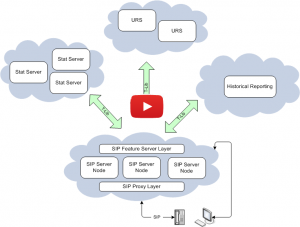
- Scalability across data centers
- As your network grows, you can add more nodes to the cluster, as needed.
- Reduced complexity related to a large number of DNs
- You create one switch, and one set of DNs, for the entire cluster. Groups of devices can be configured en masse, using a single profile.
- Architecture transparent to clients
- Devices connect and register to the cloud (through SIP Proxy), instead of to a particular node in the network.
- Business Continuity
Build a more robust network, with work area redundancy, disaster recovery, and graceful migration. - Compatibility with external SIP or T-Servers
- Ability to work with different PBX environments provides scalability on top of your existing network.