Contact center settings
A key factor in a well-configured contact center is how well the global contact centers are configured. This very important task ensures that your customers are routed to the correct agents and that the agents have the correct tools available to them as they handle customer interactions.
On the various screens, you select the check boxes next to the options that you want to enable. Each check box has three states:
 The option is inactive. To activate the option, click the check box once. The option is then set to the default setting as specified in the description in the tool tip.
 A check mark indicates that the option is enabled. You can click once to disable the option.
 No check mark indicates that the option is disabled. You can click once to enable the option.
After you configure all your objects, such as skills, dispositions, agent states, you can easily manage user accounts, because all the correct options will be available to you.
Desktop Settings
Configuring your Agent Desktop settings involves customizing the available options to meet the specific needs of your contact center. For information, see Agent Desktop settings
Skills
On the Contact Center > Manage Skills page, you can add and delete skills, as well as organize the skills into folders.
Skills are an agent's knowledge of a particular subject that might be required in an interaction, such as language skills. They can also be used for routing purposes.
To add a skill:
- Click Add.
- Type a name in the Name field.
You can organize skills into folders. If needed, you click the add folder icon  to create a new folder.
Desktop Options
High level intro to Desktop Options. See Desktop Options.
CRM Adapter settings
To configure options for the Gplus Adapter, click Contact Center Settings > CRM Adapter. For more information, see CRM Adapter settings.
Agent groups
An Agent Group is a logical grouping of agents. Agent groups are typically set up to provide particular sets of contact-center services. The Agent Groups list shows the agent groups that are in your environment. You have two options for creating agent groups:
- Create an Agent group and then manually add agents to the group. For example, if you want to create an agent group for a group of new hires, you create the agent group, and then manually add each of the new hire's agent accounts to the group.
- Create a Virtual Agent Groups to automically group agents, according to the skills that they have. You create an agent group object and define a script to identify the skills that you want the agents in the group to share. For example, you can create a virtual agent group for all agents that can speak Russian.
Both types of agent groups are configurable on the Agent Groups screen on the Contact Center Settings page. Use the following procedures create and configure your agents groups:
[+] Creating an agent group
Creating an agent group
In the Agent Groups window, type the name you want to assign to the agent group and click Add. In our example, the new agent group is a group new hires, so let's name the agent group November2016 New Agents.
You can put the new agent group into folder. This is useful for organizing your agent groups to make them easy to locate in the future. For example, you can place our new group into the Training Groups folder. When you select the Folder option, a drop-down list box is displayed where you can select a folder or click the add folder icon to create a new folder.
After you click Add, the new agent group is listed on the Agents Group page. Select the agent group you just created. Note that there are two lists:
- All Agents lists all agents in your call center.
- Agents Groups Agent lists all agents in this particular agent group. For each agent that you want to add, click the agent row in the All Agents list and drag it to the Agents Groups Agent list.
Tip
On your agent group list, you might see agent groups that have an
Add script link in the script column. If you see this, it means that you or someone else created an agent group and didn't assign any agents to it. In other words, it's an empty group. You have the option to edit the group to manually add agents or click
Add script to create a virtual agent group.
<toggledisplay linkstyle font-size:larger showtext="[+] Creating a virtual Agent group" hidetext="[-] Hide">
You can create a virtual agent group by specifying a script when you add an agent group.
As opposed to a regular agent group, you can't manually add agents to a virtual agent group. Agents are automatically included in the group if the agent is assigned the skill that is specified in the script.
After you add the script, you will see a link in the Script column on the Agent Groups page.. The script identifies the common skills shared by all agents that belong to the group. you can edit the script by double-clicking the script text and then updating the script in the dialog box that is displayed.
[+] Configuring the desktop for an agent group
After you populate your agent group with agents, you can assign objects to the group. Under each of the following tabs, make your selections:
[+] Configuring automatic answering and timeout settings
In the Desktop Options tab of the Agent Groups window, you can configure the timeout settings for the agent group. The timeout settings determine how long a chat or voice invitation remains active for an agent before it times out and then is routed to another agent.
Select Auto Answer if you want voice interactions to be automatically answered when an agent receives the invitation. If you don't select Auto Answer, configure the following values:
- Timeout(min): Specifies the minutes of agent inactivity (no mouse or keyboard usage) that triggers application locking. If the agent has been inactive longer than the number of minutes specified by this option, the agent session is ended.
- Alert before timeout(sec): Specifies the number of seconds that pass before the inactivity alert is sent to the agent.
[+] Managing global favorites for agent groups
On the Contact Center Settings tab, you can create a list of globally favorite contacts and internal targets (like other agents, team leads, or call routing) in the Team Communicator for your agents.
On the Agent Groups page, you can specify which favorites to assign to each agent group. You have a choice to add a new favorite or you can select a configured favorite.
Click Agent Groups > Group Favorites tab and then choose one of the following actions:
- Click the Global Favorites icon, select a global favorite in the Contact List dialog box, and then click Add .
- Create a new favorite. For instructions on how to create a new favorite, see Global Favorites.
Transactions
Use the Transactions tab to manage business attribute overrides that are applied at a transactional level, such as a call or a chat. You can configure the following business attributes at the transaction level:
- Dispositions
- Favorites
- Case Data
- Toast Data
- Caller IDs
Select Transactions in the navigation menu to access the Transactions tab. The Transactions tab main view lists the transactions only by name. Click the link for the transaction to view the details.
Use the following procedures create and configure transactions:
[+] How do I add a transaction?
Adding a transaction
Type a unique name in the Transaction name field, select a folder to store the transaction configuration, and then click Add. If you do not select a folder, the transaction is stored in the /default directory.
Tip
You can manage folders from this page. When you select the
Folder option, a drop-down list box is displayed where you can select a folder or click the add folder icon
to create a new folder.
Note that the name of the transaction is prefixed with the name of the folder. For example, UserPreference/<TransactionName>. At this point, configuration is not complete. You need to add business attributes to the transaction.
[+] How do I add business attributes to a transaction?
Adding business attributes to a transaction
To edit a transaction, click the link in the Name column. If the transaction has no configured business attributes, as is the case when you add a new transaction, you are prompted to complete the configuration. Follow the prompts to add Dispositions, Favorites, Case Data, Toast Data and Caller ID business attributes. After you add the business attributes, you can define them.
This image depicts the steps to add a Disposition business attribute.
[+] How do I manage dispositions?
Managing dispositions
Dispositions are the descriptions of the final outcome of the call. These codes are used to flag calls for reporting purposes. To learn more about how to manage dispositions, see Managing dispositions.
[+] How do I manage favorites?
Managing favorites
On the Favorites screen, you can create list of agents, agent groups or external contacts that agent group members frequently dial. This list provides a click-to-call list of these numbers on Agent Desktop. To learn more about how to manage favorites, see Global Favorites.
[+] How do I manage case data?
Managing case data
On the Manage Case Data screen, you can specify the information to be displayed to the agent when an interaction is transferred to them. To learn more how to manage case data, see Managing case data.
[+] How do I manage toast data?
Managing toast data
On the Manage Case and Toast Data screen, you can specify the information to be displayed to the agent hen they receive a call, chat, or other interaction. To learn more how to manage toast data, see Managing toast data.
[+] How do I manage caller IDs?
Managing caller IDs
You can allow agents to select from a predefined list of caller IDs; the selected caller ID is then displayed to the person receiving the call when the agent consults, conferences, or transfers a call. To learn more about how to manage caller IDs, see Managing caller IDs
[+] What should a configured transaction look like?
In this example, the transaction includes the following business attributes:
Disposition codes:
- Transaction complete
- Needs follow-up
Case and Toast Data
- First name
- Last name
- Subject
Caller ID
- ABC Customer Support
- ABC Shipping
Use Case
In Agent Desktop, you have the ability to override desktop options by setting the value of a KVP to the name of a transaction list object. The desktop option is interaction.override-option-key that is configured in Channels and Options. In the inbound or outbound routing application, you set the value of the identified key to the name of the transaction list object and the desktop options in the transaction list object are used instead of the WWE application or agent group objects.
Templates
Templates allow you to create a set of configuration options that you can apply to agent accounts when you add an agent. The following diagram shows the relationship between the templates and the sequence in which the templates must be created:
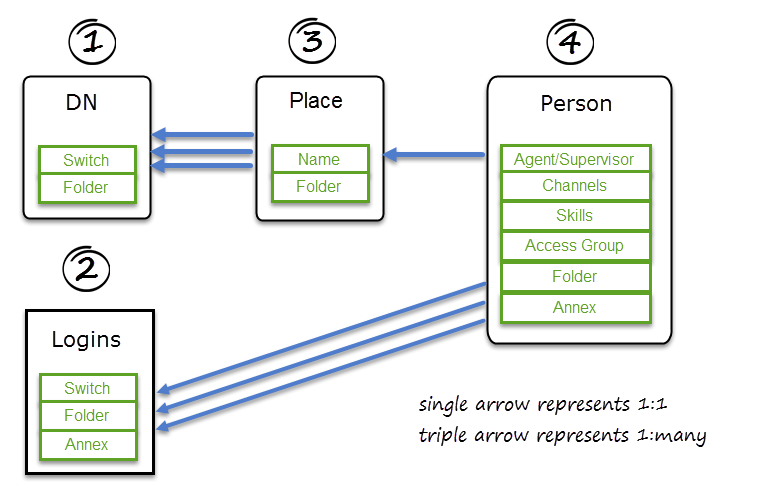
To access the Manage Templates page, click Contact Center Settings, and then click Templates.
To add a template, select a template type, and then click Add. For each template that you create, ensure that you give the template a unique name.

Click the following links to learn how to configure each template type:
[+] Click to show DN template
DN template
DN Templates specify switch and folder where the DN needs to be created.
[+] Click to show Login template
Login template
Agent Login Templates specify switch, folder, and annex options.
In the Agent Login Name field, you can use a variable to specify the contents of the field, for example, {{person.userName}}.
[+] Click to show Place template
Place template
Place Templates must contain one or more DN Templates.
If your contact center has requirement to specify unique place names for different business groups or regions, type a place name variable. For example, the place name might be the same as the agent's phone number or as the agent user name. Place names can contain the following variables:
- {{person.userName}}
- {{person.emailAddress}}
- {{phone.number}}
- {{phone.description}}
- {{phone.index}}
You can also combine variables. For example: {{person.userName}}-{{phone.index}} creates JohnAppleseed-1 and JohnAppleseed-2 if JohnAppleseed has two phone numbers.
[+] Click to show Person template
Person Templates define properties such as Channels, Skills, Access Groups, Annex options, folder, and Supervisor role for newly created agents. You also need to select a place template and one or more login template. Then you can select the channels, skills, annex, and access groups that you want to apply to this template. Before you save the Person template, select the folder where the user is created.



